Sunday, November 29, 2009

Wall Scroll #2: Figures Viewing Cherry Blossoms


This picture, aptly titled “Figures Viewing Cherry Blossoms,” describes figures that view cherry blossoms. The scene depicts a large group of people who have amassed while cherry blossoms bloom. Though most view this phenomenon in the image, some just go about on their daily life.

The coloring of this picture really draws in the viewer. The orange that dominates image really catches the eye. The contrast of the orange with the blue of the cherry blossoms also catches the attention of the viewers.

This image has a definite Buddhist influence that anyone who has seen the leaves change color in the autumn can relate to. The scene provides a familiar picture to anyone who has lived in an area that tourists visit to see the leaves change. Many people can testify that the scene where a group of people watches the changing leaves while locals try to go through their daily life is a daily occurrence for many people. In this respect, this image contrasts with the Genji image. Where the Genji image appeals to viewers because of the uniqueness of the situation, this image appeals to viewers because of the familiarity many people feel with this situation.

Wall Scroll #1: The Tale of Genji


In this segment of the wall scroll depicting a scene from The Tale of Genji, Genji pursues his future wife, Murasaki, at the age of ten. Hiding behind some bushes, Genji stalks the ten-year-old Murasaki. Murasaki, meanwhile, lives her daily life, blissfully unaware of her fate as a captive of, and later wife to Genji.

As far as the coloring goes, this image jumps out and splashes colors everywhere. The trees and the house, as a possible representation of Murasaki and her carefree life, display their blue color proudly. As a contrast, the bush Genji hides behind, possibly signifying the turmoil in the future of Murasaki, hides Genji in a sneaky red. The ground, as a theoretical neutral party to this, reflects a yellow light.

As a very Buddhist influenced piece, the people in the picture seem interchangeable. In fact, a casual viewer would have trouble discerning which of the three people Genji looks at is which. With that said, the image immediately catches the eye when one looks upon it. First, one would wonder why they see someone hiding behind a bush, and then they wonder why a stalking image is art. Finally, when they understand the story, they begin to see this as art, and analyze it closer.

Ukiyo-e Post #2: "Winter Bunnies 800"


This second wood block print, titled “Winter Bunnies 800” on google, depicts an elderly couple standing outside in a snowstorm. Unlike the last print, this print does not have much action in it. It shows a house, a tree, a man, and a woman. It does, however, have a certain appeal in its simplicity that a painting like this one would not have if it filled itself to the brim with action.

This print, like the other one, has a single dominating color—white, in this case. The snow penetrates every part of the picture. On the house, the trees, and the people, all have a layer of white on them. The sky is peppered with little white triangles that represent snowflakes, which forms a wonderful contrast with the dim grey and deep purple sky. The artist once again uses color to its fullest in this picture.

The rest of the picture, on the other hand, paints a very unassuming picture. Like the family in the picture, the houses and trees seem very basic. One can best sum up the appeal of this picture in the simplicity of the work. Everything in the picture can be seen in the average backyard during a particularly snowy day.

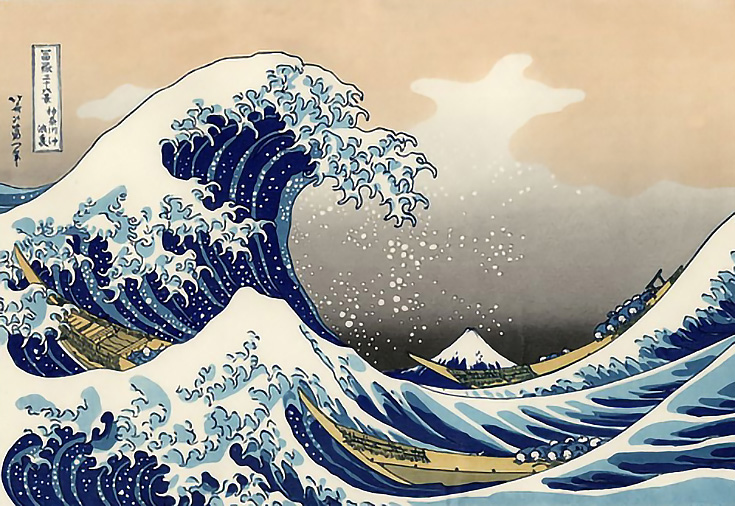
Ukiyo-e print #1: "Ukiyo-e"


This print, titled “Ukiyo-e” on google image search, depicts, at first glance, a wave and two ships. The wave forcefully eclipses both boats, and the artist clearly intended on using the wave as the focal point of the print. The background shows a mountain piercing the cloudy sky above. The whole print shows a feeling of mono no aware, with the transience of the clouds and the fleeting existence of the wave.

The coloring of the ukiyo-e print portrays the world as a rather simply colored world. The vast blueness of the ocean, contrasted with the dull brown of the boat, the flat grey of the clouds, and the retreating orange of the sky, paints the water as a mysterious, even magical entity.
The cloud in the sky displays a very Buddhist theme. In addition to the mono no aware feeling of the transience, the cloud paints itself in a very mysterious manner, hiding the sky away from the masses. Additionally, the art style feels very Zen-like, with the broad brush-strokes that make up the cloud, and the dim feeling of the cloud. The cloud also seems to be reaching out to the sky, as if attempting to encapsulate more of the sky.

The boats themselves also reveal a Buddhist theme. Neither boat show any people from what one can see, and they seem almost interchangeable. The Zen feeling permeates throughout both ships, with the total emptiness one feels when they gaze upon the ship and see the total lack of life, as if nature itself operates it.

The wave, as the focal point of the picture, shows the closest thing to an action shot in the picture. In addition to the mono no aware fleeting transience of the wave, it has a very Zen quality to it. It is, after all, just a wave. If one were to watch this scene play out, the wave would break, and then another would follow in its place.

History of Ukiyo-e Wood Block Prints and Emaki Hand Scrolls

In Japan, tradition and the ancient times dominate Japanese culture. Nowhere can one find this more eloquently displayed than in their art. When one views japanese hand scrolls, or emaki, one views a Chinese art that was introduced to Japan in the eighth century. Early Japanese hand scrolls depicted the text of a Buddhist sutra, with images deemed appropriate interspersed in. Over time, however, the hand scrolls evolved into a different, and sometimes comedic, medium to portray the traditional Japanese images.

One would call the hand scroll viewing an “intimate experience.” Generally, the viewer would unravel small sections of this scroll, to view a story painted on the scroll. As time went on, painters started to link the sections together using various methods, like clouds, would link the images together.
The images depicted on the hand scrolls changed based on the times. As previously stated, the hand scrolls started with Buddhist sutras and branched out. By the end of the Heian Period, the hand scrolls encompassed many different subjects.

Japanese Wood Block Prints, or more specifically, the ukiyo-e wood block prints, on the other hand, portray an entire scene on a small block of wood, as one would discern from the name. As with the hand scrolls, wood block prints originated in china. In another similarity with hand scrolls, wood block prints first depicted Buddhist sutras. Originally, the Japanese would print the wood block prints in black ink, and for over nine hundred years, the prints would remain in black, and only in black.

The ukiyo-e style wood block prints depict “scenes of harmony and carefree everyday living.” The style originated in the mid 17th century, and started out drawn in exclusively India ink, but in the 18th century Suzuki Harunobu discovered a manner of multicolored painting wood block prints, known as nishiki-e.

Ukiyo-e wood block prints appealed to the Japanese people because the artists made ukiyo-e for the townsmen, not the artisans. Using tracing paper, one could create many copies of a single ukiyo-e wood block print. The simple methods with which to copy them, and consequently the low price of the prints led to their immense popularity among commoners in Japan.

To make an ukiyo-e print to mass-produce, an artist went through a lengthy process. First, the artist would construct a master print, and send it off to an assistant. Afterwards, an assistant would trace it and send the trace off to a craftsman, who created a relief print to copy to the new image. After this, they send the copy to the original artist for approval, and once that is done, the printing begins.

Ukiyo-e covered many different subjects. However, the target audience limited much of what the prints covered. Due to the prints mainly targeting commoners, the prints rarely featured anyone outside of the lower strata of society. Politics also rarely appeared in these prints. Ukiyo-e wood block prints mainly focused on city life, and more specifically, on the entertainment industry. If one would look at an ukiyo-e print, they would see actors, sumo wrestlers, and courtesans.

Neither image from the wall scroll section will have the full image, as the whole images are too long for the screen, and the best images are segmented.

sources:
http://en.wikipedia.org/wiki/Ukiyo-e
http://www.asianartmall.com/AboutWoodBlockPrints.html
http://web-japan.org/museum/emaki/about_em.html
http://www.dartmouth.edu/~arth17/HandScrolls.html
http://www.google.com (for the images)